

NuVolta Launches First Charge Pump IC


Applications
Applications
About NuVolta
About NuVolta
Introduction
Wireless charging took off after the launch of the new generation of iPhones. Once, on the subway, I overheard a young guy say to a girl, "I bought a wireless charger yesterday. You just place your phone on it and it charges—so amazing!" As someone working in the wireless charging industry, I couldn't help but feel a bit proud. So, what exactly is the basic principle behind the wireless chargers on the market today? I hope this article can clear up some confusion for those already in the wireless charging field or those planning to enter it.
Reading Guide
This is not a popular science article; it requires some basic knowledge of electronics.
If you are in sales, you don't need to grasp every technical term—just understanding the overall logic is enough.
This article is short and relies mainly on diagrams to answer four fundamental questions:
- What are the main components of a wireless charging system?
- How is power transferred in wireless charging?
- What is the control loop of wireless charging?
- What is the communication mechanism in wireless charging?
What are the main components of a wireless charging system?
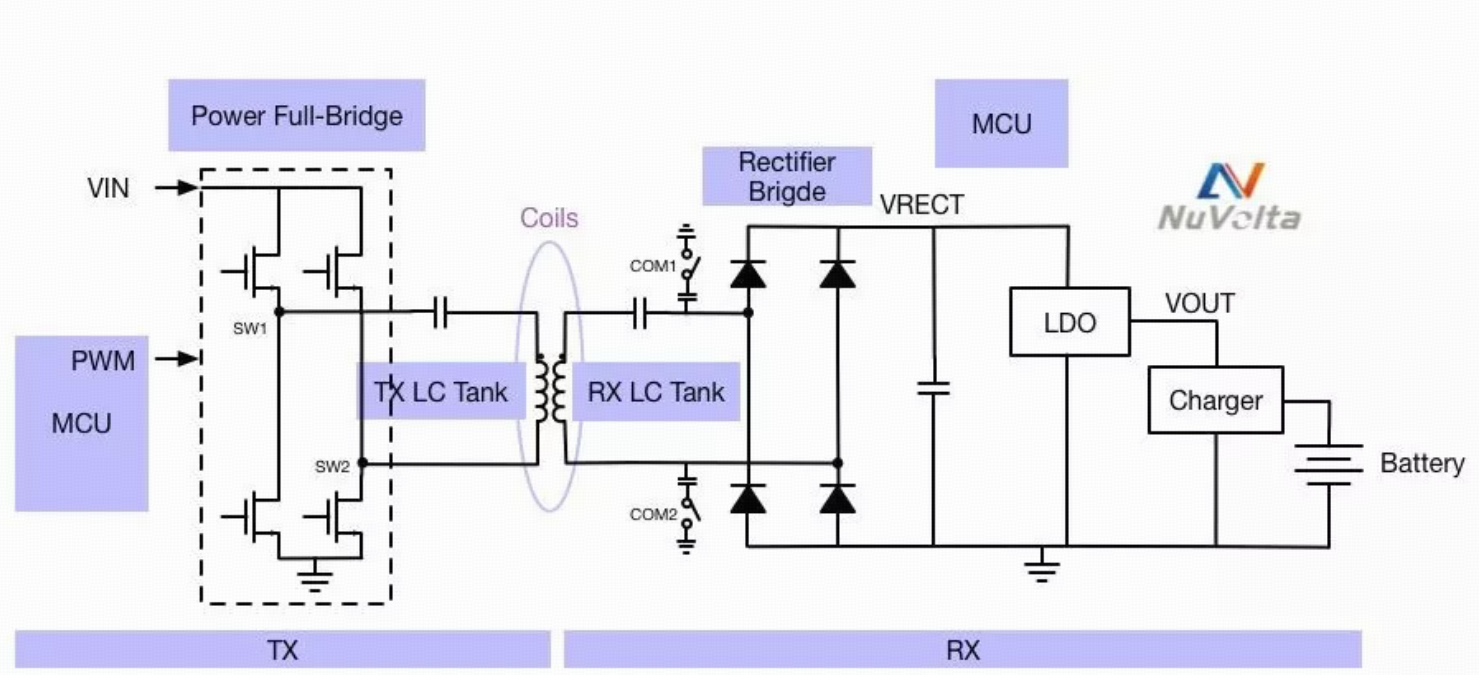
On the left is the TX (transmitter), which corresponds to the wireless charging transmitter product.
On the right is the RX (receiver), which corresponds to products with wireless charging capabilities, such as smartphones.
TX side: MCU, power full-bridge, and an LC resonant tank composed of an inductor and a capacitor—the inductor being the transmitter coil.
RX side: MCU, rectifier bridge, LDO, charger IC, battery, and an LC resonant tank—the inductor being the receiver coil.
How is power transferred in wireless charging?
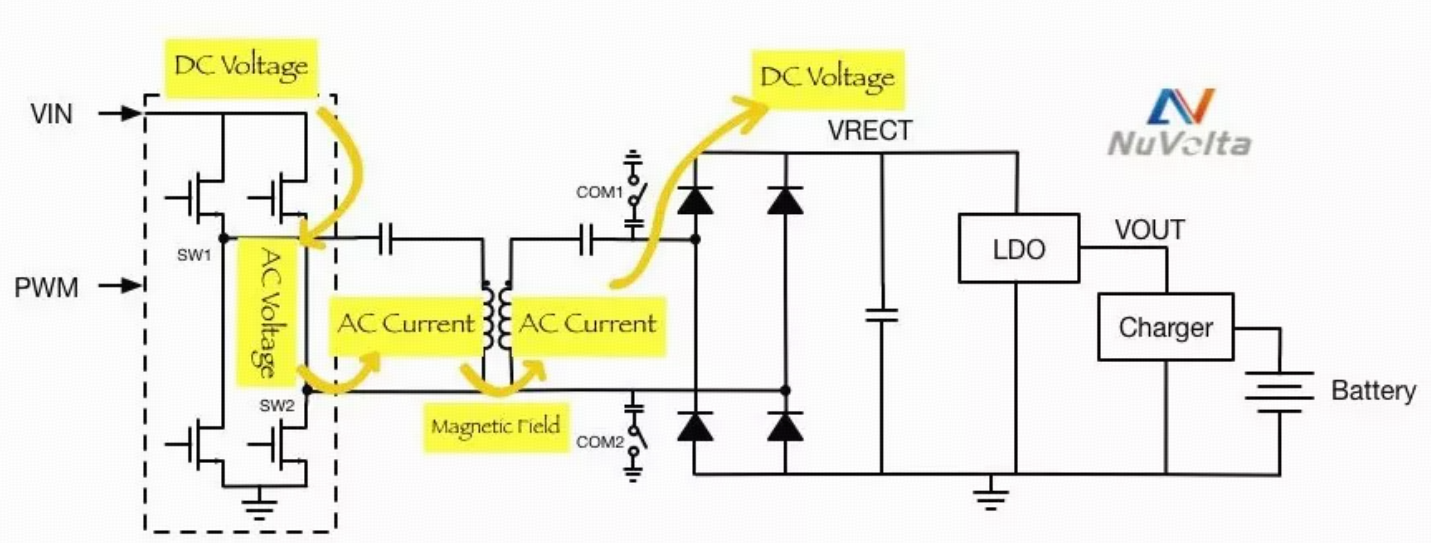
The wireless charging transmitter takes in a DC input voltage.
This DC voltage passes through the power full-bridge, generating an AC voltage (essentially a square wave) at nodes SW1 and SW2.
This square wave is applied across the LC tank, producing an AC current.
The AC current flows through the coil, generating a magnetic field.
The receiver coil picks up this magnetic field, inducing an AC current in the receiver's LC tank.
The AC current is then converted to a DC voltage by the rectifier bridge.
This DC voltage is then fed through an LDO and a charger IC to charge the battery.
What is the control loop of wireless charging?
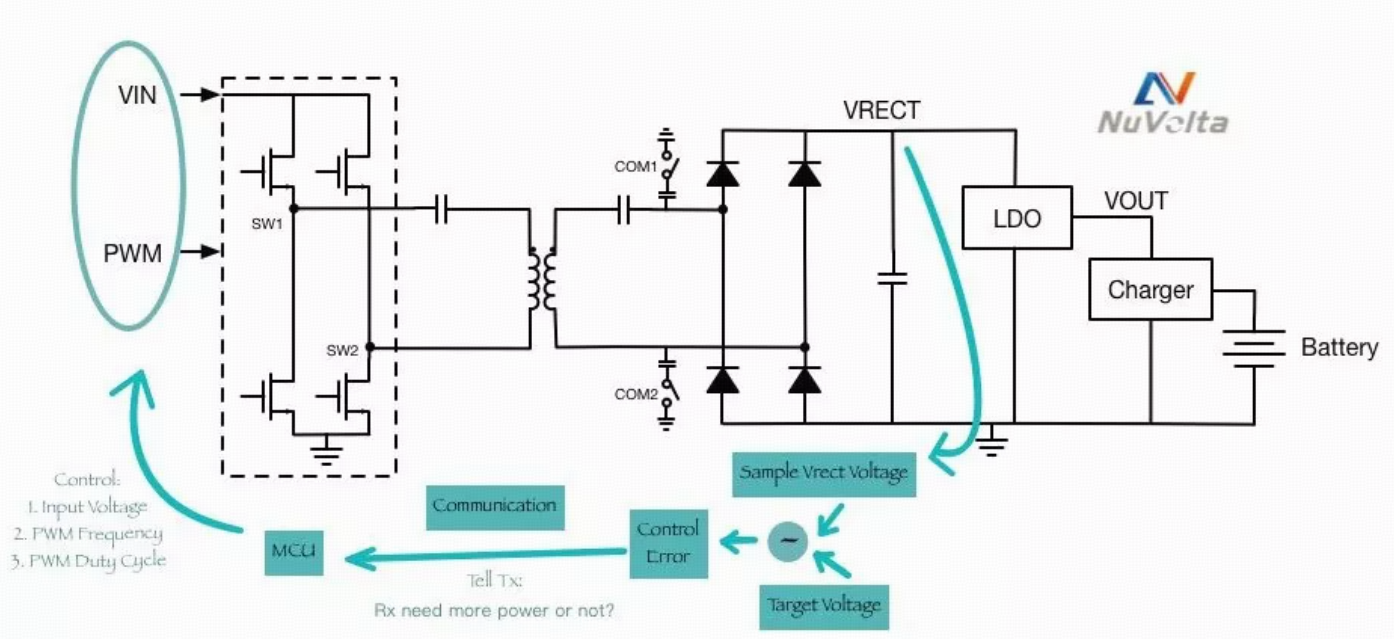
To keep the entire wireless charging system stable, VRECT needs to be regulated to a target voltage via a feedback loop. For high efficiency, this target is usually set just slightly above the LDO dropout voltage.
The feedback loop first samples the VRECT voltage and compares it with the target voltage, producing an error signal (Control Error).
This error signal is transmitted to the TX MCU via the communication method specified by the WPC standard. The MCU then determines whether the receiver is requesting more or less power from the transmitter.
The MCU controls the transmitted power through three parameters:
- Input voltage
- Switching frequency of the power full-bridge
- Duty cycle of the power full-bridge
*Note: Why can controlling these three parameters regulate the transmitted power? This will be elaborated in a future NuVolta Academy session.*
What is the communication mechanism in wireless charging?
The essence of conveying information is to create a change in a signal. For example, when I wave at you, you see my hand moving and know I'm calling you.
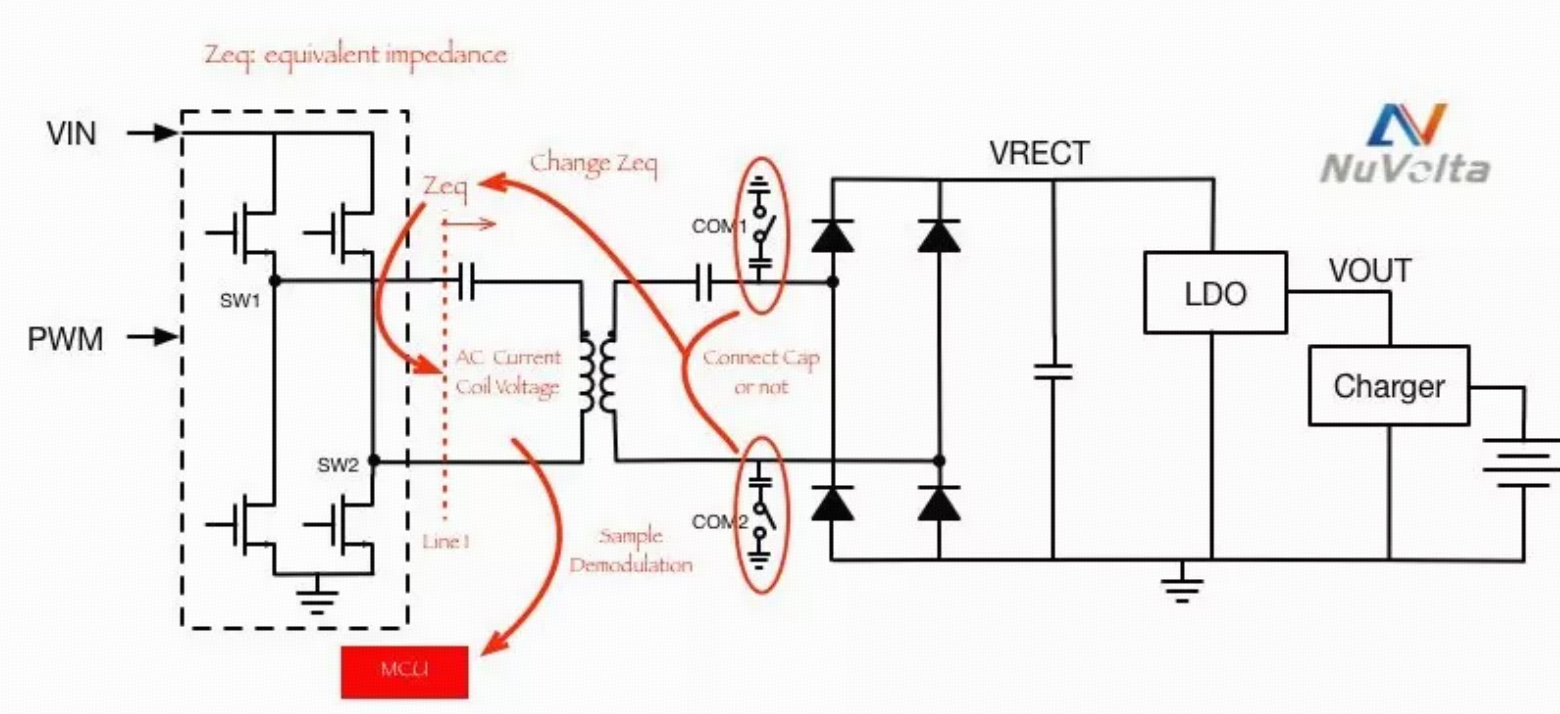
When the receiver needs to send information, it switches a capacitor in or out across its LC tank terminals.
This switching causes a change in the equivalent impedance seen by the transmitter's LC tank.
The change in equivalent impedance results in variations in the current within the transmitter's LC tank, as well as in the voltage at the junction of the coil and capacitor (Coil Voltage).
These varying signals are captured, demodulated, and sent to the MCU.
The pattern of these variations is defined in the WPC protocol. The MCU uses the WPC protocol to interpret what the receiver is telling the transmitter.
---
This concludes the first session of the NuVolta Academy.
If you have any questions, feel free to follow NuVolta and leave a comment or discussion. Corrections are also welcome. Through the NuVolta Academy, we aim to popularize wireless charging knowledge, help more people truly understand and learn about wireless charging, and ultimately promote the growth of the entire wireless charging industry.